
Melanotan I vs Melanotan II: Linear vs Cyclic Alpha-MSH Analogues
For laboratory research only. Not for human or animal use. This article gives no dosing, administration or therapeutic advice.
Short answer: Melanotan I and Melanotan II are both synthetic analogues of alpha-melanocyte-stimulating hormone (alpha-MSH), but they are built differently and behave differently at the receptor level. Melanotan I is the linear 13-residue peptide [Nle4, D-Phe7]-alpha-MSH, also called NDP-MSH and, as a drug substance, afamelanotide[1][2]. Melanotan II is a much shorter cyclic lactam covering residues 4 to 10 of alpha-MSH, with an Asp5 to Lys10 bridge[3]. The first has an approved finished product in Europe and the United States for one rare condition; the second has never been approved and is described in the literature as a superpotent but non-selective melanocortin agonist[4].
Where both peptides come from
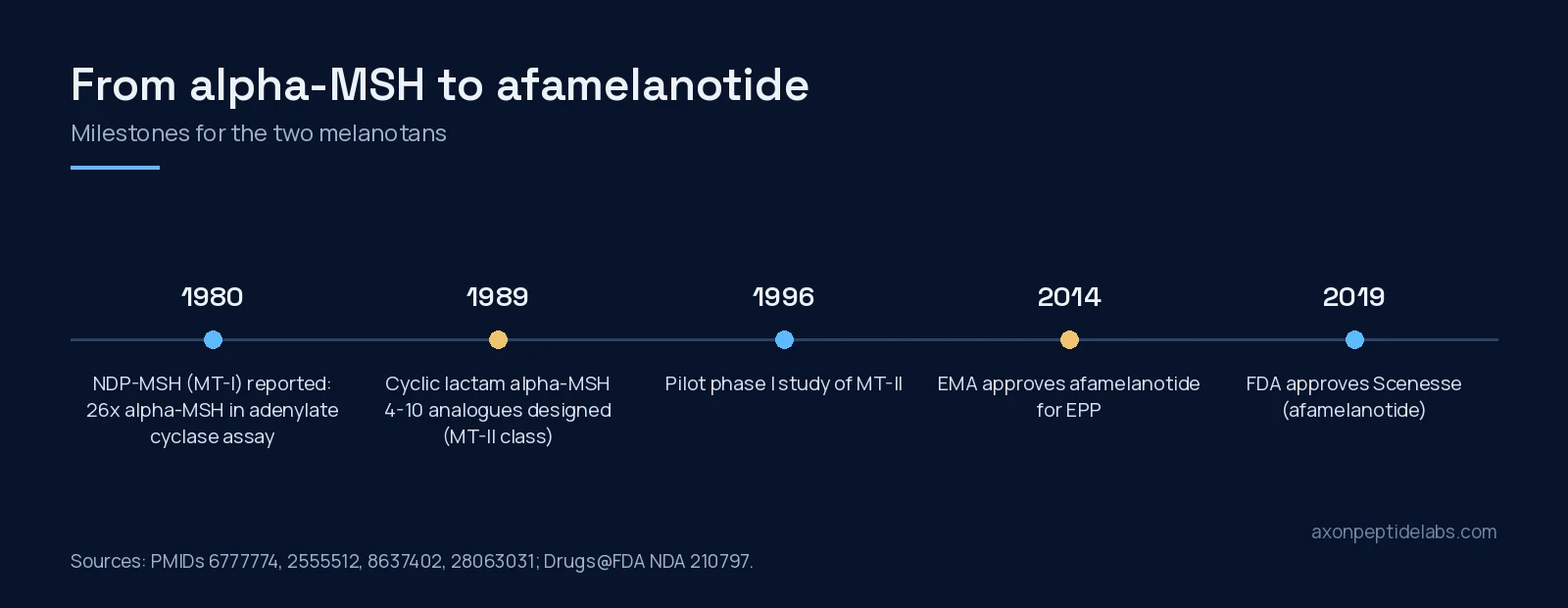
Native alpha-MSH is a 13-residue peptide (Ac-Ser-Tyr-Ser-Met-Glu-His-Phe-Arg-Trp-Gly-Lys-Pro-Val-NH2) that acts on melanocortin receptors[5]. Its usefulness as a research tool is limited by how quickly it is broken down. The 1980 paper that introduced Melanotan I started from an observation: heat-alkali treatment gave alpha-MSH a prolonged biological activity, and gas chromatography of the treated hormone showed partial racemization, especially at methionine 4 and phenylalanine 7[1].
The authors then made those two positions permanent. Replacing Met4 with norleucine and Phe7 with its D-isomer gave [Nle4, D-Phe7]-alpha-MSH. That analogue resisted degradation by serum enzymes, was 26 times as potent as alpha-MSH in a mouse melanoma adenylate cyclase assay, and also stimulated melanoma cell tyrosinase activity[1]. A later mouse toxicology paper described NDP-MSH as very slowly biodegraded in vivo and active at about one-thousandth the concentration of the natural hormone[6].
Melanotan II came from a second design step. Using structure-activity data and molecular dynamics on alpha-MSH and its superpotent analogues, a 1989 study built cyclic lactam fragments of the 4 to 10 and 4 to 13 regions, with the ring closed between an acidic residue at position 5 and a basic residue at position 10[5]. Ring size mattered. The 23-membered rings, made with Asp5 and Lys10, were about 100 times as potent as alpha-MSH in the lizard skin bioassay, while larger or smaller rings lost potency[5]. The heptapeptide that became Melanotan II has the structure Ac-Nle4-Asp5-His6-D-Phe7-Arg8-Trp9-Lys10-alpha-MSH(4-10)-NH2[3].
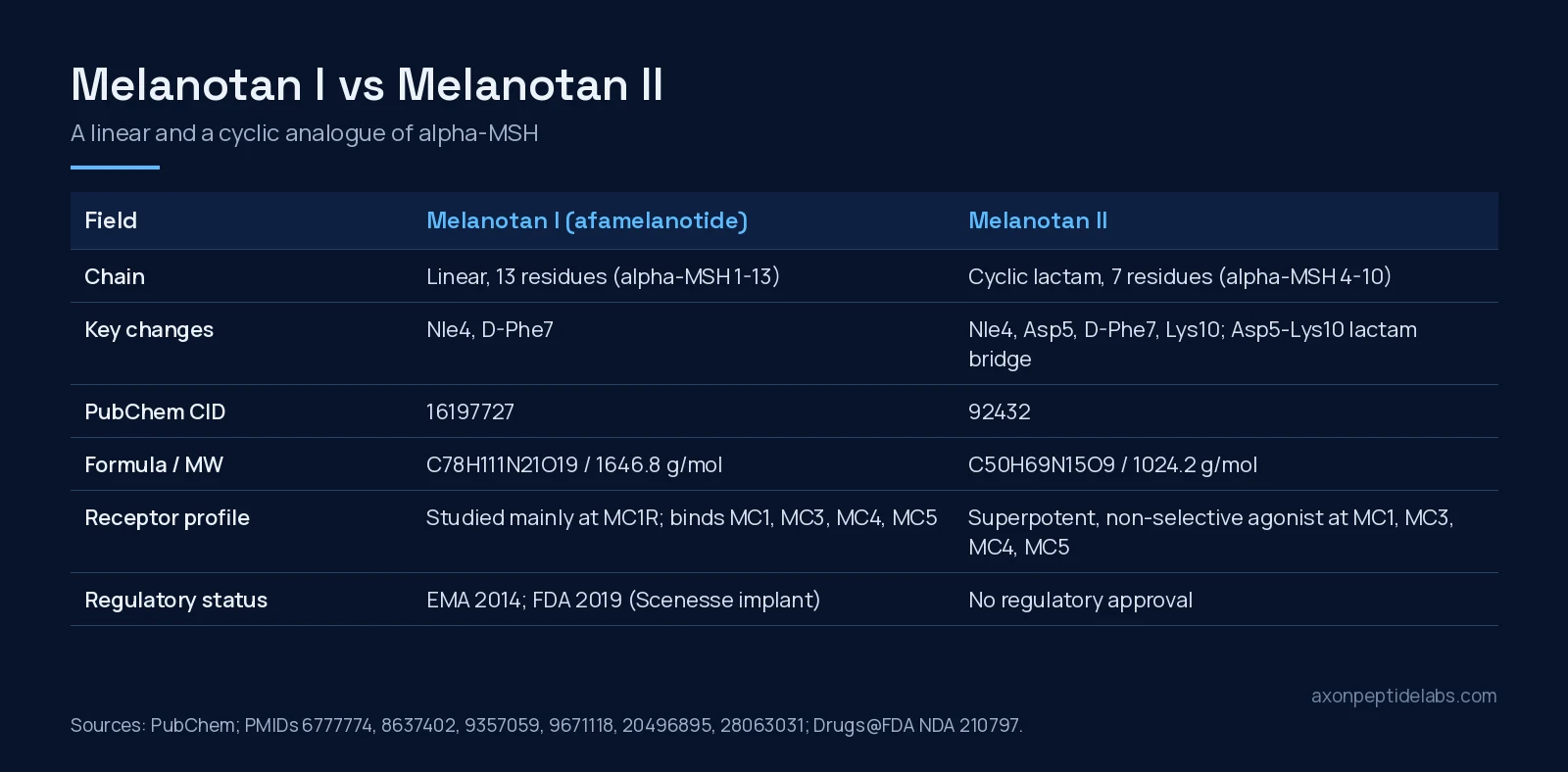
Structure and identity side by side
Identity values are from PubChem. They describe the reference compounds, not any specific batch, and are not certificate-of-analysis values.
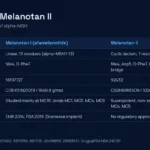
| Field | Melanotan I (afamelanotide) | Melanotan II |
|---|---|---|
| PubChem CID | 16197727 | 92432 |
| CAS (PubChem synonyms) | 75921-69-6 | 121062-08-6 |
| Other names | NDP-MSH, [Nle4, D-Phe7]-alpha-MSH | MT-II |
| Molecular formula | C78H111N21O19 | C50H69N15O9 |
| Molecular weight | 1646.8 g/mol | 1024.2 g/mol |
| Length and shape | Linear, 13 residues[1] | Cyclic lactam, 7 residues[3] |
| Changes vs alpha-MSH | Nle4, D-Phe7 | Truncated to 4-10; Nle4, Asp5, D-Phe7, Lys10; Asp5-Lys10 lactam |
| Shared core | His6-D-Phe7-Arg8-Trp9 is present in both | |
The two peptides share the same two “stabilising” substitutions, Nle4 and D-Phe7. What separates them is what was cut away and what was tied together. Melanotan I keeps the full N-terminal Ser-Tyr-Ser and the C-terminal Gly-Lys-Pro-Val. Melanotan II drops both ends and constrains the remaining core into a ring.
Receptor selectivity: the claim most comparisons get wrong
Many online comparisons call Melanotan I “selective” and Melanotan II “non-selective”. The receptor-binding literature is more nuanced. NDP-MSH and its analogues have been tested in binding assays on cells expressing human MC1, MC3, MC4 and MC5 receptors. In that work the N-terminal Ser-Tyr-Ser segment of NDP was not important for MC1 and MC4 binding but did affect MC3 and MC5 binding, while the C-terminal Gly-Lys-Pro-Val segment mattered at all four subtypes[7]. In other words, Melanotan I is a ligand at all four receptors, not an MC1R-only tool. The reason it is usually discussed in terms of MC1R is its pigmentation biology: afamelanotide binds MC1R, and MC1R signalling increases melanin synthesis[2].
For Melanotan II, a 1997 study on cells transiently expressing human MC1, MC3, MC4 and MC5 receptors tested it alongside related cyclic lactams and found that the cyclic lactams had an overall higher affinity for the MC receptors than the cyclic disulphide alpha-MSH(4-10) analogues tested in the same study[8]. Swapping D-Phe7 for D-Nal(2′)7 in the same lactam scaffold shifted selectivity toward MC4R[8], which is how the antagonist SHU9119 relates to Melanotan II. A 2010 paper described Melanotan II as superpotent but nonselective and showed that adding N-methyl groups to its backbone amide bonds improved selectivity step by step, producing potent agonists selective for human MC1R[4].
So the more accurate framing is this: both are broad melanocortin ligands. Melanotan II’s compact, rigid ring gives it high affinity across subtypes, including the central MC3 and MC4 receptors[8][9], and that is why its research footprint extends well beyond pigmentation.
What each peptide has been used to study
The research uses split along that receptor line. A 2006 review of melanocortin peptide therapeutics summarised it plainly: Melanotan I was tested clinically for skin tanning, while Melanotan II was studied for diagnosis and treatment of male erectile dysfunction, and a Melanotan II analogue, PT-141, went on to its own clinical programme[10]. Axon covers that relationship in more detail in our PT-141 vs Melanotan II comparison.
| Research area | Melanotan I | Melanotan II |
|---|---|---|
| Pigmentation and MC1R signalling | Primary focus; MC1R signalling linked to melanin synthesis, antioxidant activity and DNA repair[2] | Reported increased pigmentation in a small pilot phase I study[3] |
| Feeding and energy balance (rodents) | Not a main research use | Potent suppression of food intake in rodents, presumed via MC4R[11] |
| Brain penetration (rodents) | Not studied in the sources here | Very limited; binding seen mainly at circumventricular organs outside the blood-brain barrier[11] |
| Sexual function research | Not a main research use | Studied for erectile dysfunction; parent of PT-141[10] |
| Regulatory status | Approved finished product (see below) | No regulatory approval |
The rodent feeding work is the clearest example of Melanotan II’s broader reach. Given centrally or systemically, it produced a strong inhibitory effect on food intake in rodents. When a rat study looked for where peripherally given Melanotan II acted, autoradiography found significant labelled binding only at circumventricular organs such as the subfornical organ, median eminence and area postrema, and LC-MS/MS confirmed negligible penetration into brain tissue[11]. A separate mouse method paper reported rapid plasma clearance and low but measurable brain concentrations[9]. Those findings apply to rodents and say nothing about effects in people.
Physical chemistry and handling notes
A preformulation study measured Melanotan II’s ionisation constants (pKa about 6.54 for histidine and 11.72 for arginine) and an apparent octanol partition coefficient of 2.82 at pH 7.35, and reported a bioavailability of 4.6% in the rat[12]. Those figures describe a fairly lipophilic, compact peptide, which fits its cyclic design.
For Melanotan I, the defining property is enzymatic stability: resistance to serum enzymes was the reason the Nle4, D-Phe7 pair was chosen in the first place[1]. The approved product is a controlled-release implant, a formulation the 2017 review describes as optimising administration and effective at a lower dose than repeated saline injections[2].
Regulatory status, stated neutrally
Afamelanotide was approved by the European Medicines Agency in 2014 for the prevention of phototoxicity in adult patients with erythropoietic protoporphyria (EPP)[2]. Drugs@FDA lists an original approval for Scenesse (afamelanotide) implant dated October 8, 2019 under NDA 210797. The trial report in the New England Journal of Medicine described two multicentre, randomized, double-blind, placebo-controlled trials in EPP, one in the European Union and one in the United States[13]. We describe their design only; this article reports no efficacy results.
Melanotan II has no regulatory approval. A 2017 dermatology review noted that multiple national health organisations have issued safety warnings about unregulated Melanotan I and II products, and that a growing number of case reports describe changes in existing moles and new nevi in people using them; the authors also noted that conclusive evidence linking these events is lacking[14]. A 2012 case report described systemic toxicity and rhabdomyolysis after use of an internet-sourced Melanotan II product[15]. These reports are one more reason research material belongs in the lab and nowhere else.
What the evidence does not show
- Not interchangeable. A linear 13-mer and a cyclic 7-mer with different receptor profiles[8][7] cannot be swapped in an assay and expected to give the same answer.
- “Selective” is relative. Melanotan I binds MC1, MC3, MC4 and MC5 receptors[7]; its MC1R reputation comes from its pigmentation use.
- Rodent data stay rodent data. The feeding and brain-penetration results for Melanotan II come from rats and mice[11][9].
- The approval is narrow. It covers one finished afamelanotide product for one indication. A research-grade peptide sold for laboratory use is not that product and carries no approval.
Sourcing for your lab
Axon carries Melanotan I 10mg and Melanotan II 10mg for laboratory research, alongside other compounds in our skin and hair peptides category. Batch documentation, where posted, is on our COA page. For the bremelanotide side of this family, see PT-141 10mg. To compare our wider catalogue, you can buy lab-tested peptides in Canada with documentation listed by batch.
Frequently asked questions
Is Melanotan I the same as afamelanotide?
Yes. Melanotan I is [Nle4, D-Phe7]-alpha-MSH, also called NDP-MSH, and afamelanotide is the drug-substance name for the same peptide. PubChem lists it under CID 16197727.
What is the structural difference between Melanotan I and Melanotan II?
Melanotan I is a linear 13-residue analogue of alpha-MSH with norleucine at position 4 and D-phenylalanine at position 7. Melanotan II keeps only residues 4 to 10, uses the same Nle4 and D-Phe7 changes, and is closed into a ring by a lactam bridge between Asp5 and Lys10.
Is Melanotan I selective for MC1R?
Not strictly. NDP-MSH binds human MC1, MC3, MC4 and MC5 receptors in binding assays. It is mostly discussed in terms of MC1R because MC1R signalling drives the pigmentation effects it was developed to study.
Why is Melanotan II studied for more than pigmentation?
It is a superpotent, non-selective melanocortin agonist with high affinity across receptor subtypes, including MC3R and MC4R. In rodents it strongly suppresses food intake, and it was also studied in sexual-function research, which led to the analogue PT-141.
Are Melanotan I or Melanotan II approved?
Afamelanotide was approved by the EMA in 2014 and by the FDA in 2019 as a specific implant product for erythropoietic protoporphyria. Melanotan II has no regulatory approval. Research-grade peptides are for laboratory use only.
References
- Sawyer TK, Sanfilippo PJ, Hruby VJ et al. (1980). 4-Norleucine, 7-D-phenylalanine-alpha-melanocyte-stimulating hormone: a highly potent alpha-melanotropin with ultralong biological activity. Proc Natl Acad Sci U S A. PMID: 6777774. doi: 10.1073/pnas.77.10.5754.
- Minder EI, Barman-Aksoezen J, Schneider-Yin X (2017). Pharmacokinetics and Pharmacodynamics of Afamelanotide and its Clinical Use in Treating Dermatologic Disorders. Clin Pharmacokinet. PMID: 28063031. doi: 10.1007/s40262-016-0501-5.
- Dorr RT, Lines R, Levine N et al. (1996). Evaluation of melanotan-II, a superpotent cyclic melanotropic peptide in a pilot phase-I clinical study. Life Sci. PMID: 8637402. doi: 10.1016/0024-3205(96)00160-9.
- Doedens L, Opperer F, Cai M et al. (2010). Multiple N-methylation of MT-II backbone amide bonds leads to melanocortin receptor subtype hMC1R selectivity: pharmacological and conformational studies. J Am Chem Soc. PMID: 20496895. doi: 10.1021/ja101428m.
- Al-Obeidi F, Castrucci AM, Hadley ME et al. (1989). Potent and prolonged acting cyclic lactam analogues of alpha-melanotropin: design based on molecular dynamics. J Med Chem. PMID: 2555512. doi: 10.1021/jm00132a010.
- Dorr RT, Dawson BV, al-Obeidi F et al. (1988). Toxicologic studies of a superpotent alpha-melanotropin, [Nle4, D-Phe7]alpha-MSH. Invest New Drugs. PMID: 2852652. doi: 10.1007/BF00173642.
- Schiöth HB, Mutulis F, Muceniece R et al. (1998). Selective properties of C- and N-terminals and core residues of the melanocyte-stimulating hormone on binding to the human melanocortin receptor subtypes. Eur J Pharmacol. PMID: 9671118. doi: 10.1016/s0014-2999(98)00212-x.
- Schiöth HB, Müceniece R, Mutulis F et al. (1997). Selectivity of cyclic [D-Nal7] and [D-Phe7] substituted MSH analogues for the melanocortin receptor subtypes. Peptides. PMID: 9357059. doi: 10.1016/s0196-9781(97)00079-x.
- Hatziieremia S, Kostomitsopoulos N, Balafas V et al. (2007). A liquid chromatographic/tandem mass spectroscopic method for quantification of the cyclic peptide melanotan-II. Plasma and brain tissue concentrations following administration in mice. Rapid Commun Mass Spectrom. PMID: 17610239. doi: 10.1002/rcm.3106.
- Hadley ME, Dorr RT (2006). Melanocortin peptide therapeutics: historical milestones, clinical studies and commercialization. Peptides. PMID: 16412534. doi: 10.1016/j.peptides.2005.01.029.
- Trivedi P, Jiang M, Tamvakopoulos CC et al. (2003). Exploring the site of anorectic action of peripherally administered synthetic melanocortin peptide MT-II in rats. Brain Res. PMID: 12834882. doi: 10.1016/s0006-8993(03)02683-0.
- Lan EL, Ugwu SO, Blanchard J et al. (1994). Preformulation studies with melanotan-II: a potential skin cancer chemopreventive peptide. J Pharm Sci. PMID: 7983590. doi: 10.1002/jps.2600830805.
- Langendonk JG, Balwani M, Anderson KE et al. (2015). Afamelanotide for Erythropoietic Protoporphyria. N Engl J Med. PMID: 26132941. doi: 10.1056/NEJMoa1411481.
- Habbema L, Halk AB, Neumann M et al. (2017). Risks of unregulated use of alpha-melanocyte-stimulating hormone analogues: a review. Int J Dermatol. PMID: 28266027. doi: 10.1111/ijd.13585.
- Nelson ME, Bryant SM, Aks SE (2012). Melanotan II injection resulting in systemic toxicity and rhabdomyolysis. Clin Toxicol (Phila). PMID: 23121206. doi: 10.3109/15563650.2012.740637.